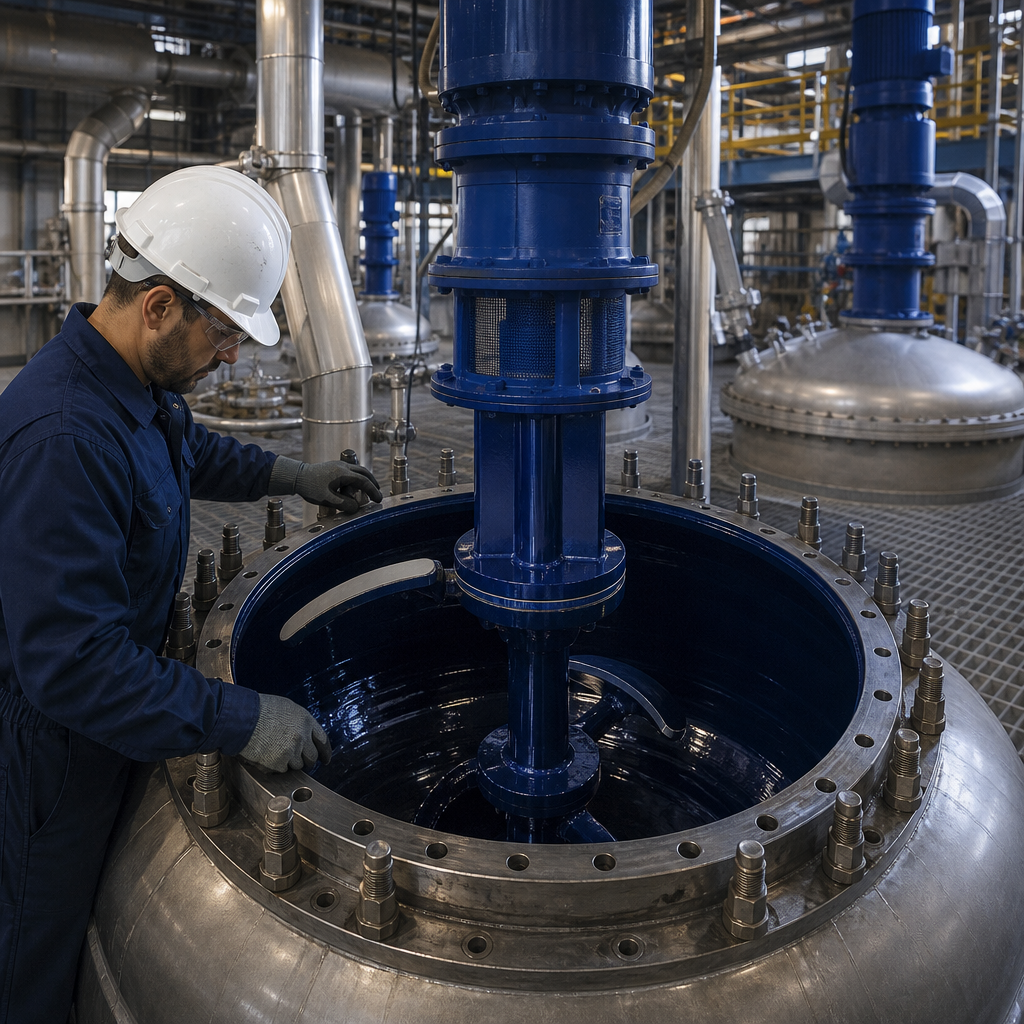
In the world of industrial process engineering, the materials used to construct mixing and reaction equipment can make or break the integrity of an entire production line. When processes involve highly corrosive chemicals, reactive compounds, or pharmaceutical-grade substances, standard stainless steel or carbon steel equipment simply cannot provide the level of protection required. This is where glass lined technology has become an indispensable solution — offering a chemically inert barrier that safeguards both the equipment and the product being processed. Among the most critical components in this category, agitators stand out as the mechanical heart of any mixing vessel, and their design demands exceptional engineering attention.
Understanding the Role of Agitators in Process Equipment
Agitators are mechanical devices installed within reactors and mixing vessels to ensure uniform blending, heat transfer, and chemical reaction throughout a batch. In industries such as pharmaceuticals, specialty chemicals, agrochemicals, and food processing, the agitator must perform consistently under demanding conditions — including elevated temperatures, pressures, and exposure to aggressive solvents or acids. The design of an agitator directly influences mixing efficiency, reaction yield, and product quality. A poorly designed or inadequately protected agitator can introduce contamination, cause premature equipment failure, or compromise the chemical purity of the final product.
Why Glass Lining Changes Everything
Glass lining is a specialized process in which a layer of borosilicate glass is fused onto the surface of steel equipment at extremely high temperatures. The result is a smooth, non-porous, chemically resistant surface that is virtually impervious to most acids, solvents, and organic compounds. Unlike coatings or polymer linings, glass lining becomes a permanent part of the substrate — it does not peel, delaminate, or absorb process fluids. This makes it the preferred choice for processes where contamination control is paramount and where the chemical environment would rapidly degrade unprotected metal surfaces.
The Specific Demands Placed on Glass Lined Agitators
A glass lined agitator must satisfy a unique combination of mechanical and chemical requirements that few other components face simultaneously. The agitator shaft and impeller blades must be robust enough to handle the torque and shear forces generated during mixing, while the glass lining must remain perfectly intact under those same mechanical stresses. Any crack or chip in the glass surface can expose the underlying steel to corrosive media, leading to contamination and equipment failure. This is why the manufacturing of glass lined agitators demands precision engineering, rigorous quality control, and thorough inspection protocols — including spark testing and visual examination — before any component is approved for service.
Impeller Design and Mixing Dynamics
The geometry of the impeller blades on a glass lined agitator is carefully engineered to achieve specific flow patterns within the reactor vessel. Anchor-type impellers are commonly used in glass lined reactors because they sweep close to the vessel walls, promoting heat transfer and preventing product buildup. Retreat curve impellers offer excellent bulk mixing with lower shear, making them suitable for sensitive pharmaceutical reactions. The choice of impeller design depends on the viscosity of the process fluid, the required mixing intensity, and the nature of the chemical reaction taking place. Engineers must balance these factors carefully, as the glass lining adds constraints on blade geometry and surface finish that do not apply to unlined equipment.
Heat Transfer and Temperature Control in Glass Lined Systems
One of the most important functions of an agitator in a glass lined reactor is to enhance heat transfer between the process fluid and the jacketed vessel wall. Efficient heat transfer is critical for controlling exothermic reactions, maintaining product quality, and reducing batch cycle times. The agitator promotes convective heat transfer by continuously moving fluid across the heated or cooled vessel surface. However, the glass lining itself has a lower thermal conductivity than bare steel, which means that agitator design must compensate by maximizing fluid velocity near the vessel walls. This interplay between agitator performance and thermal management is a key consideration in the engineering of glass lined process systems.
Comparing Glass Lined Mixing to Other Heating Technologies
Industrial heating and mixing technologies span a wide range of applications and principles. While glass lined reactors use jacketed heating with precise temperature control, other industries employ entirely different approaches to achieve thermal processing goals. For example, wood-fired hot tub heating systems demonstrate how direct combustion can be used to transfer heat to a fluid medium — a concept that, while vastly different in scale and application, shares the fundamental principle of controlled thermal energy transfer. Understanding these diverse heating methodologies helps engineers appreciate the sophistication required in industrial glass lined systems, where temperature uniformity and contamination control are non-negotiable.
Continuous Mixing vs. Batch Processing in Corrosive Environments
The debate between continuous mixing and batch processing is a longstanding one in process engineering. Batch reactors with glass lined agitators have traditionally dominated industries where flexibility, small production volumes, and stringent cleaning requirements are priorities. However, continuous mixing technologies are gaining traction in certain sectors. Research and development in continuous mixing — such as the work demonstrated in continuous mixing studies conducted in specialized R&D laboratories — is pushing the boundaries of what is possible in high-throughput production environments. For corrosive chemical processes, however, the glass lined batch reactor remains the gold standard due to its superior containment, cleanability, and chemical resistance.
International Process Plants: A Trusted Source for Glass Lined Components
When sourcing glass lined process equipment, the quality and provenance of individual components matter enormously. International Process Plants has established itself as a reputable supplier of pre-owned and refurbished process equipment, offering a comprehensive inventory of glass lined parts including agitators, reactors, and associated components. Their inventory is carefully inspected and documented, providing buyers with confidence in the mechanical and chemical integrity of each piece. For process engineers and plant managers seeking cost-effective solutions without compromising on quality, accessing a reliable inventory of glass lined components through a trusted supplier can significantly reduce capital expenditure while maintaining operational standards.
Maintenance, Inspection, and Longevity of Glass Lined Agitators
Proper maintenance of glass lined agitators is essential to maximizing their service life and protecting the investment they represent. Regular inspection using holiday detectors or spark testers can identify microscopic defects in the glass surface before they develop into larger failures. Operators must also be vigilant about thermal shock — rapid temperature changes can cause the glass lining to crack, particularly if the vessel is heated or cooled too quickly. Mechanical impacts from solid materials or improper cleaning tools can also damage the lining. When damage does occur, specialized repair kits using tantalum plugs or PTFE patches can restore the integrity of the lining in localized areas, extending the useful life of the agitator without requiring full replacement.
Conclusion: Precision Engineering for Demanding Applications
Glass lined agitators represent one of the most technically demanding components in industrial process engineering. They must simultaneously deliver reliable mechanical performance, maintain chemical inertness, and support efficient heat transfer — all within the constraints imposed by the glass lining itself. As industries continue to push the boundaries of chemical processing, the demand for high-quality glass lined equipment will only grow. Whether sourcing new components or carefully evaluated pre-owned equipment, process engineers must prioritize quality, traceability, and technical expertise to ensure that their glass lined systems perform safely and efficiently over the long term.