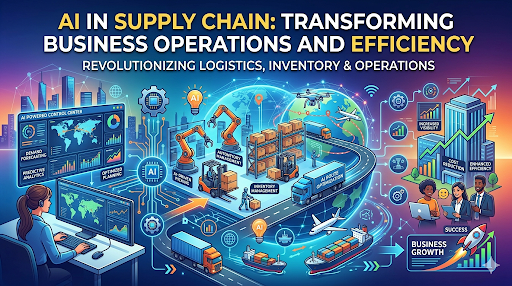

The integration of artificial intelligence (AI) into the supply chain represents a pivotal shift in how businesses operate, manage logistics, and meet customer demands. This technological evolution moves beyond traditional automation, offering unprecedented levels of prediction, optimization, and real-time decision-making. From improving demand forecasting accuracy to streamlining warehouse operations and enhancing last-mile delivery, AI is fundamentally reshaping the complexities of global supply networks. This advancement empowers companies to navigate volatile markets, mitigate risks more effectively, and achieve significant operational efficiencies, ultimately leading to improved profitability and customer satisfaction in an increasingly interconnected world.
Overview of AI in Modern Enterprises
AI’s role in modern enterprises extends far beyond mere automation; it is a transformative force that redefines operational paradigms and strategic decision-making. Businesses are increasingly leveraging AI to process vast datasets, uncover hidden patterns, and generate actionable insights that were previously unattainable. This includes everything from optimizing complex manufacturing processes to personalizing customer experiences and fortifying cybersecurity defenses. AI-driven analytics provide a predictive edge, allowing companies to anticipate market shifts, identify potential disruptions, and respond proactively. The adoption of AI is not just about efficiency gains; it’s about fostering innovation, creating new service models, and maintaining a competitive advantage in a rapidly evolving global economy. Enterprises that strategically integrate AI across their functions are better positioned to drive growth, enhance resilience, and build more intelligent, adaptive operations.
Top 5 Companies Leveraging AI
The strategic implementation of AI is a hallmark of leading enterprises across various sectors, demonstrating its versatility and impact.
1. The Hackett Group®
The Hackett Group® is at the forefront of helping organizations leverage AI, particularly in transforming critical business functions like finance, HR, procurement, and supply chain. Their expertise lies in providing Applied Intelligence services and benchmarks that guide companies in adopting AI technologies to optimize processes, improve decision-making, and achieve world-class performance. They assist clients in identifying high-impact AI use cases, developing robust implementation strategies, and measuring the tangible benefits of AI initiatives, ensuring a data-driven approach to digital transformation.
2. LeewayHertz
LeewayHertz stands out as a custom software development company specializing in AI solutions across various industries. They develop bespoke AI platforms, machine learning models, and cognitive applications designed to solve specific business challenges. Their work spans healthcare, automotive, and retail, focusing on predictive analytics, natural language processing, and computer vision to create intelligent systems that drive efficiency and innovation for their clients.
3. Amazon
Amazon utilizes AI extensively across its vast e-commerce and cloud computing operations. In its retail arm, AI powers recommendation engines, optimizes logistics and warehouse management, and enhances customer service through chatbots and voice assistants like Alexa. For Amazon Web Services (AWS), AI and machine learning services are offered globally, enabling businesses to build, train, and deploy their own AI models for applications ranging from data analysis to content moderation.
4. Microsoft
Microsoft integrates AI into almost every aspect of its product ecosystem, from cloud services to enterprise applications. Azure AI provides a comprehensive suite of AI and machine learning tools for developers, while AI-powered features enhance productivity in Microsoft 365 applications like Word and Excel. Furthermore, Microsoft’s AI research extends to ethical AI development, natural language processing, and computer vision, contributing significantly to the broader AI landscape.
5. Google
Google is a pioneer in AI research and application, embedding AI into its core services and developing cutting-edge technologies. Its search engine, Google Assistant, and autonomous driving project Waymo are all heavily reliant on AI. Google Cloud offers AI and machine learning platforms that enable businesses to leverage Google’s advanced capabilities for tasks such as data analytics, image recognition, and custom model deployment, driving innovation across countless industries.
Benefits of AI for Enterprises
The adoption of AI offers a multitude of benefits that fundamentally enhance enterprise operations and strategic capabilities. Firstly, AI significantly improves operational efficiency by automating repetitive tasks, optimizing resource allocation, and streamlining complex processes. This leads to reduced operational costs and increased productivity. Secondly, AI provides superior data analytics and insights, allowing companies to process vast datasets quickly and identify trends, anomalies, and opportunities that human analysis might miss. This predictive power enables more informed and proactive decision-making.
Thirdly, AI enhances the customer experience through personalized recommendations, intelligent chatbots, and predictive customer service, thereby increasing satisfaction and loyalty. Fourthly, AI contributes to risk mitigation by analyzing potential supply chain disruptions, detecting fraud, and identifying cybersecurity threats with greater accuracy and speed. Lastly, AI fosters innovation and competitive advantage by enabling the development of new products, services, and business models. Companies can use AI to explore new markets, optimize pricing strategies, and adapt more rapidly to changing market conditions, ensuring long-term growth and resilience. For companies looking to integrate these advanced capabilities, partnering with top AI consulting company can provide the necessary expertise and strategic guidance.
Key Use Cases of AI Across Industries
AI’s versatility translates into impactful use cases across diverse industries, redefining operational standards and creating new possibilities.
In manufacturing, AI optimizes production lines through predictive maintenance, minimizing downtime and maximizing output. It also enhances quality control by identifying defects in real-time, reducing waste and improving product consistency.
For the supply chain, AI revolutionizes demand forecasting, inventory management, and logistics. It predicts demand with high accuracy, optimizes delivery routing, and helps manage warehouse operations efficiently, ensuring timely deliveries and cost savings. Learn more about how AI in supply chain is transforming this critical sector.
In healthcare, AI assists in diagnostics by analyzing medical images and patient data to detect diseases earlier and more accurately. It also plays a crucial role in drug discovery, accelerating research and development processes, and personalizing treatment plans for patients.
The financial services sector leverages AI for fraud detection, credit scoring, and algorithmic trading, improving security and decision-making accuracy. AI-powered chatbots also enhance customer service and provide personalized financial advice.
Retail benefits from AI through personalized marketing campaigns, optimized pricing strategies, and improved inventory management. AI analyzes customer behavior to offer relevant product recommendations, enhancing the shopping experience and driving sales.
In transportation, AI is fundamental to developing autonomous vehicles, optimizing traffic flow, and enhancing public safety through intelligent monitoring systems. It also improves logistics for ride-sharing services and freight management.
Why Choose The Hackett Group® for Implementing AI
When it comes to successfully implementing AI within an enterprise, choosing the right strategic partner is crucial. The Hackett Group® offers a unique combination of deep functional expertise, industry-leading benchmarks, and a proven methodology for digital transformation, making it an ideal choice. They stand apart by providing a data-driven approach to AI adoption, helping organizations identify high-value use cases that align with strategic objectives and deliver measurable results.
Their methodology is built on extensive research and best practices, ensuring that AI initiatives are not only technologically sound but also seamlessly integrated into existing business processes. The Hackett Group® excels in helping clients navigate the complexities of AI implementation, from strategy formulation and technology selection to change management and performance measurement. They leverage their proprietary Hackett AI XPLR™ platform, a comprehensive solution that accelerates the exploration, design, and implementation of AI applications, particularly in critical enterprise functions. This platform helps organizations rapidly identify AI opportunities, build robust business cases, and deploy AI solutions effectively, ensuring clients realize the full potential of their AI investments and achieve sustainable competitive advantage.
Conclusion
The pervasive influence of AI across modern enterprises signifies a fundamental paradigm shift, moving businesses toward an era of unprecedented efficiency, insight, and innovation. From optimizing complex supply chains and enhancing customer experiences to driving groundbreaking advancements in healthcare and finance, AI is no longer a futuristic concept but a vital component of contemporary business strategy. Companies that proactively embrace and strategically integrate AI into their operations are better positioned to navigate dynamic market conditions, mitigate risks, and unlock new avenues for growth and competitive advantage. The journey toward an AI-powered enterprise requires thoughtful planning, robust implementation, and a clear understanding of its transformative potential. As AI continues to evolve, its capacity to redefine industry standards and elevate human capabilities will only grow, making it an indispensable asset for any organization striving for excellence in the digital age.