


Ortigia does not divide its history neatly into separate districts. Ancient columns appear beside everyday streets, medieval stonework survives behind later additions, and Baroque façades rise above spaces whose origins reach much further into the past. This small island at the heart of Syracuse has absorbed repeated changes without losing the traces of what came before. Greeks, Romans, Byzantines, Arabs, Normans, Swabians and later Sicilian rulers all contributed to the city that exists today. The pleasure of exploring Ortigia comes from seeing those periods occupy the same streets, sometimes even the same building. History here is less a sequence of vanished worlds than a collection of layers that remain visible beneath the present.
Why is Ortigia the starting point for understanding ancient Syracuse?
Ortigia was the original nucleus from which Greek Syracuse developed after settlers from Corinth established a colony here in the eighth century BC. The settlement later expanded onto the Sicilian mainland and became one of the most important cities of the Greek Mediterranean.
The island’s compact size makes that distant history unusually approachable. Ancient remains are not isolated in a remote archaeological zone. They sit within a living neighbourhood of houses, shops, cafés and churches.
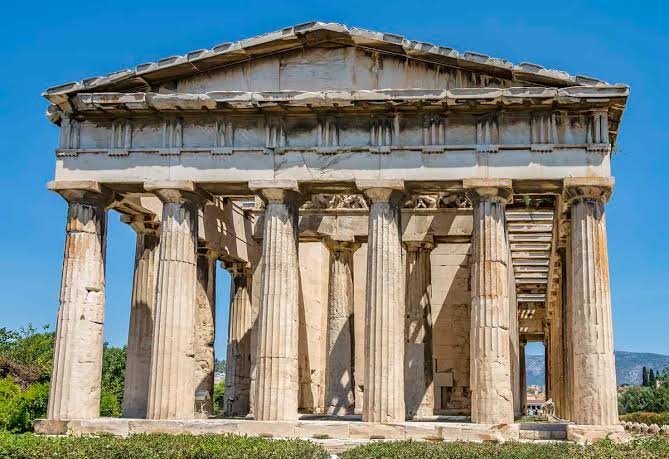
Near the entrance to Ortigia, the surviving columns of the Temple of Apollo provide an immediate reminder of this first Greek city. Built in the early sixth century BC, the structure was later adapted for very different purposes under successive rulers. Its long afterlife is typical of Syracuse, where buildings were frequently reused rather than simply abandoned.
How does Syracuse Cathedral contain different periods of history?
Piazza Duomo offers the clearest expression of Ortigia’s layered character. At first sight, the Cathedral belongs to the elegant Baroque setting of the square. Looking more closely changes that impression.
The building incorporates the ancient Temple of Athena, erected in the fifth century BC. Doric columns from the temple remain embedded in the walls of the cathedral, making the ancient structure part of the later Christian building rather than an archaeological ruin standing beside it.
This produces one of Ortigia’s most remarkable architectural experiences. A visitor can stand before an eighteenth-century façade, enter a Christian cathedral and still encounter the structure of a Greek sanctuary.
Few buildings explain Syracuse so efficiently: its history has often advanced by transforming what was already there.
Why does Baroque architecture dominate the appearance of Ortigia today?
The Baroque character of southeastern Sicily is closely connected with disaster. A devastating earthquake struck the region in 1693, damaging Syracuse and destroying or seriously affecting buildings across the Val di Noto.
Reconstruction gave architects an opportunity to reshape façades, churches and public spaces according to the tastes of the period. In Ortigia, the street plan largely survived while many buildings acquired the theatrical stonework now associated with the historic centre. Piazza Duomo reached much of its present appearance during this rebuilding phase.
This explains an apparent contradiction. Ortigia is ancient in origin, yet much of what visitors immediately notice belongs to a considerably later age. The Baroque city did not replace the older one completely; it became another visible surface above it.
What should you notice while walking through Ortigia?
The island is small enough for distances to become almost irrelevant. The more useful way to explore is to pay attention to transitions.
A grand square can narrow suddenly into a residential lane. Elaborate balconies appear above simple stone walls. Religious buildings stand beside palaces from different centuries, while fragments of earlier structures occasionally interrupt the later city.
Via della Maestranza is particularly rewarding for observing noble façades and balconies, while the streets around the Giudecca reveal a denser and more intimate side of Ortigia. Walking south eventually brings the city towards the sea and Castello Maniace, where another historical period enters the picture.
Travellers who stay at an Ortigia luxury hotel can easily return to these streets at different times of day, when changes in light alter the colour and texture of the pale local stone.
What does Castello Maniace add to the story of Syracuse?
At the southern end of the island, Castello Maniace shifts the architectural language again. The fortress is associated with the reign of Frederick II and the medieval history of Sicily, creating a striking contrast with both Greek ruins and later Baroque architecture.
Its position is equally important. Ortigia projects into the sea, and the castle makes clear how closely the history of Syracuse was tied to maritime access and defence.
From this end of the island, the geography becomes easier to understand. Ortigia was not simply an attractive place to build a city. Its relationship with the harbour and surrounding waters contributed to its strategic importance throughout different periods of Mediterranean history.
Why is the Fountain of Arethusa important to Ortigia?
Not every historical layer is architectural. Myth also forms part of Syracuse’s identity.
Near the western waterfront, the Fountain of Arethusa is a natural spring traditionally associated with the Greek story of the nymph Arethusa and the river god Alpheus. The myth created an imaginative connection between Sicily and Greece, linking the new colony with the cultural world from which its settlers had come.
Today the spring, with its papyrus plants, provides a quieter stop between the dense streets and the sea. Its importance lies partly in that continuity: an element of the natural landscape became a mythological landmark and remains part of the identity of Ortigia thousands of years later.
Is it worth leaving Ortigia to explore ancient Syracuse?
Yes, because the island tells only the opening chapters.
On the mainland, the Neapolis Archaeological Park preserves evidence of the much larger city that developed beyond Ortigia. The Greek Theatre is the best-known monument, accompanied by ancient quarries, the Altar of Hieron II and the Roman amphitheatre. UNESCO recognises ancient Syracuse together with the Necropolis of Pantalica as a cultural landscape demonstrating roughly three millennia of Mediterranean civilisation.
Visiting Neapolis also changes the sense of scale. Ortigia feels intimate because later centuries continued building over its ancient fabric. The archaeological zone instead makes it easier to imagine the size and ambition of classical Syracuse.
The two experiences complement one another rather than compete.
How much time does Ortigia deserve?
A single day is enough to see its principal landmarks, but it is not necessarily enough to understand the island.
Two or three days allow the pace to slow. Piazza Duomo can be revisited in the evening, the waterfront can be walked near sunset and smaller churches or courtyards can be entered without worrying about the next scheduled stop.
Time also makes the historical layers easier to distinguish. On a quick visit, Ortigia can appear simply beautiful. After repeated walks, differences emerge between ancient fragments, medieval structures, Baroque reconstruction and later additions.
That gradual recognition is part of the experience.
Ortigia is a city built through reuse
Many historic destinations preserve their past by separating it from contemporary life. Ortigia rarely offers that kind of distance.
A Greek temple became part of a cathedral. Ancient streets remained relevant to later communities. Medieval fortifications continued to define the edge of the island, while Baroque rebuilding gave old public spaces a new architectural identity.
The result is not a perfectly preserved city from any single period. Ortigia is compelling precisely because no century has been allowed the final word.
Walk from the Temple of Apollo to Piazza Duomo, continue towards the Fountain of Arethusa and finish beside the sea at Castello Maniace, and the distance covered is modest. Historically, however, the journey crosses an extraordinary span of Mediterranean civilisation. In Ortigia, those centuries are not hidden beneath the modern city. They are what the modern city is made from.




