
When an AI recommends a business, it is not just reading that business’s own website. It is drawing on everything the wider web says about them: the press coverage, the industry mentions, the directory entries, the forum threads. The picture it builds comes from many sources, and the businesses that appear in more of those trusted sources are the ones it recommends with confidence. Your own site tells the AI what you say about yourself. Everywhere else tells it what the world says about you, and that carries more weight.
This is why digital PR matters for AI visibility. Getting mentioned on the sites AI looks at is one of the most powerful ways to become a business it trusts and names. It is not about chasing links for their own sake, the old game that earned SEO a bad name. It is about earning genuine mentions on credible, relevant sources, so that when AI assembles its view of your market, you are part of the picture rather than absent from it.
This guide explains what digital PR for AI visibility actually means, where AI looks when it forms an opinion of you, why mentions and citations matter as much as links, and a practical method for earning them. It is written for businesses that want to build lasting authority, not buy shortcuts that stop working the moment anyone checks.
What digital PR for AI visibility is
Digital PR is the practice of earning mentions, coverage and citations across the web through genuinely useful or newsworthy work. Applied to AI visibility, it has a specific goal: to make your business appear, consistently and credibly, in the sources AI draws on when it answers questions about your market.
That is a slightly different aim from traditional PR, which chases coverage for its own sake, and from old-fashioned link building, which chased links regardless of quality. Digital PR for AI visibility sits between the two. It cares about being mentioned in the right places, by credible sources, in a way that reinforces who you are and what you are good at. The mention itself is the prize, whether or not it carries a link, because AI reads mentions as evidence.
Put simply, it is how you build the off-site reputation that AI reads. Your website is within your control and AI knows it. What others say about you is harder to fake and therefore more trusted, which is exactly why it moves the needle when your own pages alone do not.
It is worth being clear that this is a long game played honestly. There are no tricks here that survive contact with a discerning AI, and that is a feature rather than a limitation. Because the only thing that reliably works is genuine reputation, the businesses willing to build it are rewarded with a lead that cannot simply be bought overnight.
Where AI looks when it forms a view of you
To do digital PR well, you have to know where AI is looking. When it builds an answer about your market, it draws on a range of sources beyond your own site, and each one shapes the impression it forms.
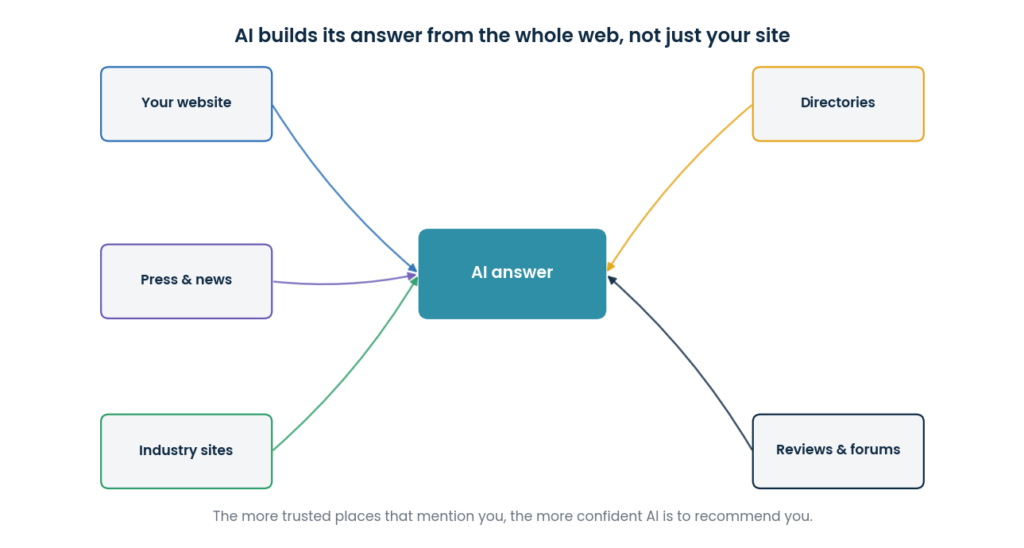
AI assembles its answer from many sources. Being present and consistent across them builds its confidence in you.
It reads your own website, which sets out your claims. It reads press and news coverage, which lends outside credibility. It reads industry and sector sites, which signal that you belong in your field. It reads directories and listings, which corroborate your details. And it reads reviews and community discussion, which reveal what customers actually say. No single source decides the outcome. The pattern across all of them does.
The practical lesson is that presence in more of these trusted places makes AI more confident about you. A business mentioned only on its own site is making an unsupported claim. A business mentioned across the press, its industry and independent sources is making a claim the AI can corroborate, and corroboration is what turns a maybe into a recommendation. Digital PR is how you get into those other places.
Why mentions and citations matter, not just links
Here is a shift that trips up anyone coming from traditional SEO. In the old world, a mention was only valuable if it carried a link. For AI visibility, the mention itself matters, linked or not, because AI reads the text and understands that your business has been referenced in a credible context.
An unlinked mention on a respected industry site still tells the AI that you exist, that you operate in this field, and that a credible source thought you worth naming. It builds the association between your business and your area of expertise, and it strengthens the wider reputation AI reads. Third-party mentions are, in effect, among the strongest trust signals for AI recommendations there are, precisely because you cannot simply write them about yourself.
This widens the field enormously. You are no longer limited to opportunities that hand you a link. Any credible mention of your business, in the right context, contributes to how AI sees you. That makes digital PR both easier and more valuable than old link building, because you are pursuing genuine reputation rather than a narrow technical prize, and reputation is what AI is ultimately trying to measure.
How this differs from old link building
It is worth drawing the contrast sharply, because the habits of old link building actively work against you now.
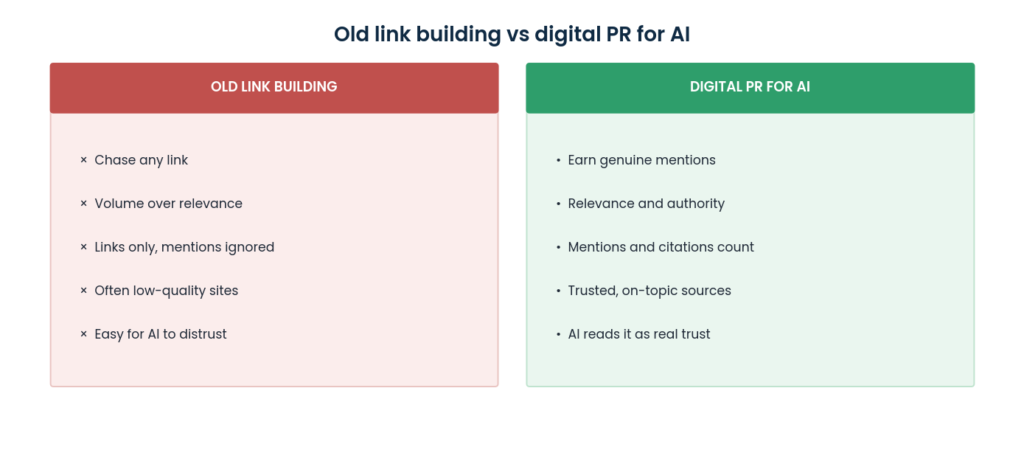
The old link-building instincts backfire. Digital PR earns the genuine trust AI is looking for.
Old link building chased volume and treated any link as a win, regardless of where it came from. It often meant low-quality sites, irrelevant placements, and tactics that looked exactly like the manipulation they were. AI, like modern search, is good at spotting that pattern, and a pile of poor mentions can do more harm than good by making your profile look engineered rather than earned.
Digital PR for AI visibility inverts the priorities. It values relevance and credibility over volume, genuine mentions over manufactured links, and the trust of a few respected sources over the noise of many poor ones. One mention in a publication your industry respects is worth more than fifty in places nobody trusts. The work is harder, but it builds something durable, and durability is the whole point when the alternative stops working the moment it is examined.
Why this matters more for AI than for search
Digital PR helped in traditional search too, mostly through the links it produced. For AI visibility it matters even more, and for a subtly different reason. A search engine largely counted your links. An AI reads and synthesises what sources say about you, forming something closer to an opinion than a score.
That means the substance of a mention counts, not just its existence. When a respected industry source describes what you do, and does it well, the AI absorbs that description into its understanding of you. A mention that says you are a trusted local specialist in a particular service teaches the AI exactly that, in a way a bare link never could. You are not just accumulating signals. You are shaping the story the AI tells about you.
This raises the value of quality mentions considerably. A single article that describes your business accurately and favourably, on a source the AI trusts, can shift how you are represented across many answers. It is less like collecting points and more like building a reputation that gets repeated, which is exactly how word of mouth has always worked, now mediated by a machine.
The digital PR method
Earning mentions is not luck. It follows a method, and while it takes effort, none of it is mysterious. Here are the five steps.
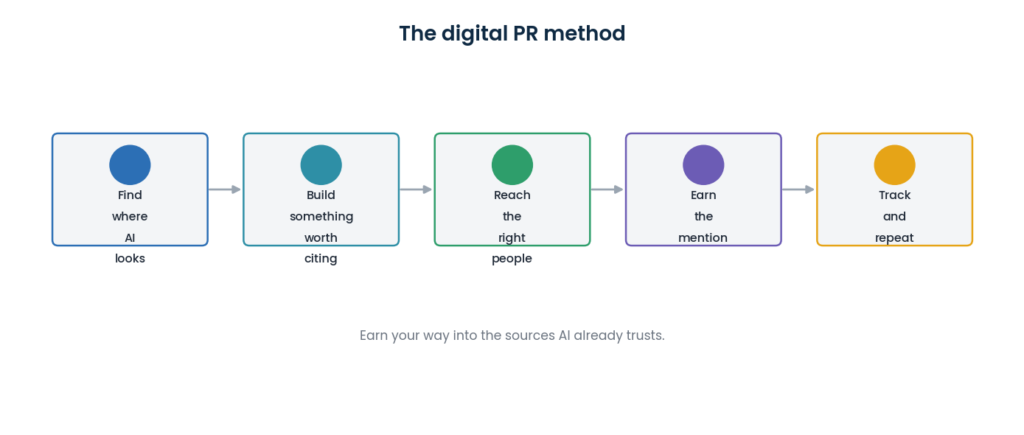
A repeatable method: earn your way into the sources AI already trusts.
- Find where AI looks in your market. Identify the sources that matter in your field: the trade publications, respected local outlets, industry sites and directories that AI is likely to draw on. These are your targets, and knowing them focuses everything that follows.
- Build something worth citing. Create the asset that earns a mention, whether that is original data, expert commentary, a genuinely useful resource, or a newsworthy local story. Nobody mentions you for existing. They mention you for offering something worth referencing.
- Reach the right people. Get your asset in front of the journalists, editors and site owners who cover your area. This is outreach: a clear, relevant, useful approach to people who might genuinely want what you have, not a mass email to everyone.
- Earn the mention. When someone covers you, references your data, or quotes you, you have earned a credible mention in a place AI reads. Make it easy for them to do so accurately, with clear facts and correct details.
- Track and repeat. Monitor where you get mentioned, note what worked, and do more of it. Digital PR compounds: each credible mention makes the next one easier, and the cumulative picture is what AI reads.
What actually earns you a mention
Step two is where most digital PR succeeds or fails, so it deserves detail. You earn mentions by offering something genuinely worth referencing. A few kinds of asset work especially well.
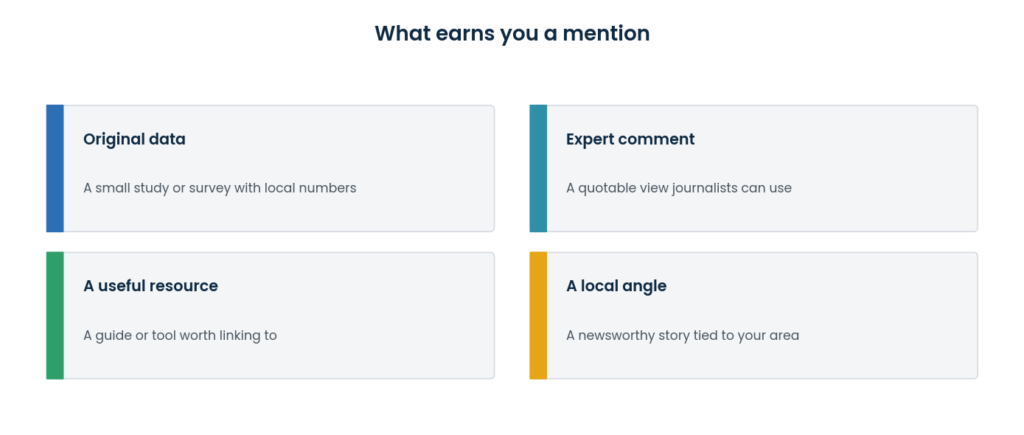
Four reliable ways to become worth mentioning. Each gives a credible source a reason to name you.
Original data. A small study, survey or set of local numbers gives journalists something they cannot get elsewhere, and data is the single most reliable way to earn coverage. It does not need to be large. It needs to be genuine, specific and relevant to your area.
Expert commentary. A clear, quotable view on something happening in your field makes you a useful source. Journalists constantly need informed comment, and being the person who provides it, promptly and well, earns repeated mentions over time.
A genuinely useful resource. A guide, tool or piece of research that others want to reference earns mentions naturally, because people link to and cite things that help their own audience. Useful outlasts clever.
A newsworthy local angle. A story tied to your area, a local trend, a community initiative, a response to something happening nearby, gives regional outlets a reason to cover you, and regional coverage is both achievable and credible.
Where to get mentioned
Once you have something worth referencing, you need to reach the people who might reference it. Alongside directly contacting relevant publications, a few services exist specifically to connect sources with journalists who need them, and they are a practical starting point for a business without a PR agency.
In the UK, ResponseSource runs a long-established journalist enquiry service that sends reporters’ requests to relevant sources, and it is well suited to businesses wanting national, regional or trade coverage. Internationally, Qwoted and Featured connect experts with journalists looking for comment and insight. Watching these for requests in your field, and answering quickly and usefully, is one of the simplest ways to earn credible mentions.
These platforms reward speed and relevance rather than budget. A prompt, genuinely useful reply to a journalist’s request will often beat a slower, vaguer one from a bigger name, which makes them a level playing field where a small business can win real coverage. Treat them as a habit, not a one-off, and the mentions accumulate.
How long it takes to pay off
Digital PR is not an overnight tactic, and it helps to set expectations honestly. Earning credible mentions takes time, and the view AI holds of you updates gradually as those mentions accumulate and are re-read across the web. You are building reputation, and reputation tends to compound slowly before it compounds quickly.
In practice, the first mentions can come within weeks if you have a genuinely useful asset and pitch it well, but the cumulative effect on your AI visibility builds over months. The pattern is encouraging, though: unlike paid tactics that stop the moment you stop paying, earned mentions persist. An article that references you keeps working long after it is published, and the reputation it contributes to does not evaporate.
The right mindset is patient and consistent. A steady rhythm of small, credible mentions beats a single big push followed by silence, because AI reads the ongoing pattern. Treat digital PR as a habit you maintain rather than a campaign you finish, and the results accumulate into something competitors find very hard to displace.
Common mistakes
A few errors waste digital PR effort, and they are worth naming so you can sidestep them.
Chasing links, not relevance. Pursuing any mention anywhere, regardless of whether the source is credible or relevant, recreates the old link-building mistake. Aim for the right places, not the most places.
Pitching nothing worth covering. Outreach fails when there is no real asset behind it. Build something worth mentioning before you ask anyone to mention it.
Ignoring unlinked mentions. Dismissing a mention because it carries no link misses the point for AI visibility. A credible unlinked mention still builds your reputation, so value it.
Being slow. Journalists work to deadlines. A brilliant reply that arrives after the story has run is worthless. Speed is often the difference between a mention and a miss.
Treating it as one-off. A single burst of PR fades. Digital PR works when it is sustained, because reputation is built steadily and read cumulatively by AI.
A worked example: a windows and doors company
A windows and doors company in West Sussex had a solid website but almost no presence anywhere else. When people asked AI for recommendations in its market, it rarely appeared, while competitors who cropped up in local press and industry sites were named repeatedly. Its own claims about quality had nothing outside its site to back them up.
Rather than chase links, the company built something worth mentioning. It surveyed a few hundred local homeowners about draughty windows and rising energy bills, and turned the results into a short, genuinely local data study. The numbers were specific, timely and relevant to a story journalists were already covering, which made them easy to pick up.
It shared the study with regional outlets and answered a couple of relevant journalist requests with clear, quotable comment. Over a few months it earned mentions in local press and a trade publication, some linked and some not. None of that changed the company’s product. What it changed was the web’s view of the company, and therefore the AI’s. Where its claims had once stood alone, they were now corroborated by credible outside sources, and it began appearing in the recommendations it had been missing. The mentions did the work its website could not do alone.
What helped the company, once it started, was that its rivals were not doing this at all. A single genuinely local data study was enough to stand out, because almost nobody in its market had thought to create one. That is often the case: digital PR feels like hard work precisely because most competitors avoid it, which is exactly why the businesses that do it earn a lead that is difficult to catch.
Frequently asked questions
What is digital PR for AI visibility?
It is the practice of earning genuine mentions, coverage and citations on the credible sources AI draws on, so that your business appears consistently in its answers. The aim is to build an off-site reputation AI can corroborate, rather than to chase links for their own sake.
Do the mentions need to include a link?
No. For AI visibility, an unlinked mention on a credible, relevant source still counts, because AI reads the text and understands your business has been referenced in a trustworthy context. Links help for other reasons, but the mention itself carries real value.
How is this different from old link building?
Old link building chased volume and treated any link as a win, which AI now reads as manipulation. Digital PR for AI visibility values relevance and credibility over volume, and genuine mentions over manufactured links. One respected mention beats fifty poor ones.
What earns a mention most reliably?
Original data is the most dependable, because it gives journalists something they cannot get elsewhere. Expert commentary, genuinely useful resources, and newsworthy local angles also work well. The common thread is offering something worth referencing.
How do I find journalists to pitch?
Contact relevant publications directly, and use journalist request services that connect sources with reporters who need them. In the UK, ResponseSource is well established, and Qwoted and Featured are widely used more broadly. Answer relevant requests quickly and usefully.
Earn your place where AI looks
AI recommends the businesses the wider web vouches for, not just the ones with the tidiest homepage. Digital PR is how you earn that outside endorsement: by building things worth referencing and getting them in front of the credible sources AI reads. It is slower than buying links, and far more durable, because it builds genuine reputation rather than a facade that collapses under scrutiny.
Start with one asset. Gather a small piece of local data, or prepare a clear, quotable view on something happening in your field, and offer it to the outlets and journalists who cover your area. One credible mention makes the next easier, and over time you build the corroborated reputation that AI turns into recommendations.
If you would like help planning and running digital PR that builds your AI visibility, from finding where AI looks in your market to earning the mentions that matter, get in touch and we will map the sources shaping your reputation and how to earn your place among them.
The businesses that win at this are rarely the loudest. They are the ones that made themselves genuinely worth mentioning, then did the patient work of getting mentioned, again and again, until the wider web, and the AI reading it, could not describe their market without naming them.