
In recent years, one of the significant shifts in how we build EHR is the use of APIs. Almost everything from EHR integration to other healthcare applications is now connected through APIs.
While this makes data exchange seamless, enables real-time data access, and supports a scalable ecosystem, it also creates some security risks. Because the more connected systems become, the more entry points it creates for cybersecurity threats.
That’s why it is important to guard these entry points, and that is where healthcare API security becomes non-negotiable. When APIs connect two systems, they move sensitive Patient Health Information (PHI), and this is why limiting who can access the data is important.
And that’s where OAuth 2.0 healthcare security comes in and helps control access to patient data, and ensures only authorized and authenticated personnel can interact with patient data. Moreover, API security in healthcare is becoming foundational as healthcare is transforming with AI and other technologies.
In this blog, we will break down how OAuth 2.0 works in healthcare APIs and some of the best practices for healthcare API security for implementing healthcare data security.
Understanding OAuth 2.0 in Healthcare
When you connect healthcare systems with APIs, the goal is to share data without endangering sensitive PHI. And as I said earlier, that is where OAuth 2.0 plays the biggest role. If I define it in simple terms, it is a security framework that only allows authorized users and applications to access patient data through secure, time-limited tokens.
However, it is important for you to understand that both authentication and authorization are different. Because authentication validates who the user is, and authorization defines what data they can access.
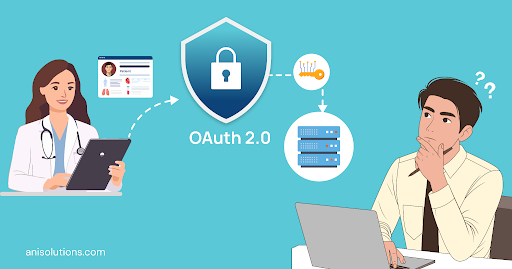
And OAuth 2.0 focuses on authorization, making sure that applications can only access data that is granted by the user or the system. Let’s understand how this works through an example. When a clinician opens an application and requests access, the application redirects them to an authentication server.
After logging in and getting approval, the system gives an access token, and the application can use this token to access patient data via APIs, without giving login credentials. This approach improves API security in healthcare by controlling access and preventing unnecessary exposure of patient data, supporting secure interoperability.
Key Security Patterns Every Healthcare API Should Use
If OAuth 2.0 is the foundation, these patterns are what make healthcare API security actually hold up in the real world. Without them, even a well-designed system can become vulnerable.
First, the Authorization Code Flow with PKCE is essential. It protects against authorization code interception, especially in mobile and browser-based applications. By adding a dynamic code verifier, PKCE ensures that even if a code is intercepted, it can’t be exchanged for a valid token. Today, this is a baseline requirement—not an advanced feature.
Next is scope-based access control. Every token should grant only the minimum permissions required. For example, if an app only needs to read lab results, it shouldn’t have write access to medications. Over-permissioned scopes are one of the most common gaps in API security in healthcare, and they significantly increase risk exposure.
OpenID Connect (OIDC) adds another critical layer by handling identity verification. While OAuth manages access, OIDC ensures the user’s identity is authenticated, which is crucial for audit trails and compliance.
Finally, preventing token misuse is key. This includes using short-lived tokens, secure transmission over TLS, and mechanisms to detect replay attacks. Tokens should be treated like sensitive credentials—because they are.
Managing Tokens Securely
While tokens are a secure way to access data, if they are not handled properly and can break healthcare data security. So, start with short-lived access tokens. These should typically expire within 15–30 minutes. The idea is simple: even if a token is compromised, the damage window stays small. Long-lived tokens might feel convenient, but they significantly increase risk.
Then comes refresh token management. Instead of issuing long-lasting access, systems should rely on refresh tokens to obtain new ones. But here’s the catch: refresh tokens must be tightly controlled. Best practice is refresh token rotation, where each use invalidates the previous token. This helps detect replay attacks and prevents silent misuse.
Storage is another weak spot in many implementations. Tokens should never be stored in browser-accessible locations like localStorage or passed through URLs. Instead, use HTTP-only cookies, secure server-side storage, or platform-specific secure storage (like mobile keychains). This reduces exposure to attacks like cross-site scripting.
Also critical is enforcing the least-privilege principle. Every token should grant only the access required, nothing extra. Over-scoped tokens create unnecessary risk.
In short, strong token management isn’t optional. It’s a core part of API security in healthcare, ensuring that access remains controlled, traceable, and resilient against modern attack patterns.
Strengthening Security Beyond OAuth
OAuth 2.0 is essential—but on its own, it’s not enough to guarantee strong healthcare API security. Real-world systems need multiple layers of protection working together.
One of the most important additions is mutual TLS (mTLS). While standard TLS encrypts data in transit, mTLS goes a step further by verifying both the client and the server. This ensures that not only is the connection secure, but the system making the request is trusted. For system-to-system communication—especially when handling PHI—this adds a critical layer of assurance.
Next comes the role of API gateways. These act as a centralized control point for managing traffic and enforcing policies. They help with rate limiting, authentication checks, and blocking suspicious activity. If an application suddenly starts making an unusual number of requests, the gateway can flag or stop it before it becomes a bigger issue.
Equally important is monitoring and audit logging. Every API interaction should be tracked—who accessed what data, when, and under which permissions. This isn’t just about compliance; it’s how organizations detect anomalies, investigate incidents, and maintain accountability.
Ultimately, strong healthcare data security relies on a layered approach. OAuth handles authorization, but combining it with mTLS, gateways, and continuous monitoring creates a system that’s far more resilient against evolving threats.
Common Mistakes to Avoid
Here’s the uncomfortable truth: most failures in healthcare API security don’t come from advanced attacks; they come from basic implementation mistakes.
One of the biggest is still using the implicit grant flow. It was designed for an earlier web and exposes tokens in browser URLs, making them easier to intercept. Modern standards strongly recommend moving to the authorization code flow with PKCE instead.
Another common issue is weak redirect URI validation. If redirect URIs aren’t strictly validated, attackers can manipulate the flow and capture authorization codes or tokens. This is a simple fix, but often overlooked.
Then there are over-permissioned scopes. Granting broad access “just in case” defeats the purpose of OAuth. Every token should follow the least-privilege principle. Anything more is unnecessary risk.
Long-lived tokens are another frequent problem. While they reduce friction, they create a much larger window for misuse if compromised. Short-lived tokens with proper refresh mechanisms are far safer.
Finally, many systems lack proper monitoring and audit controls. Without visibility into API activity, it’s nearly impossible to detect suspicious behavior or respond quickly to incidents.
These mistakes aren’t hard to fix, but ignoring them can quietly undermine even well-designed API security in healthcare systems.
Challenges in Real-World Implementation
The biggest hurdle is legacy systems. Many healthcare platforms weren’t built for modern authentication standards like OAuth 2.0. They still rely on basic authentication or static credentials, and upgrading them isn’t always feasible. The practical workaround is to place an API gateway or identity layer in front, adding modern security without touching the core system.
Then there’s the complexity of multi-vendor environments. Different EHRs and platforms implement OAuth slightly differently, varying scopes, token lifecycles, and authorization behaviors. This creates friction for developers and increases the risk of inconsistent security controls. Most organizations solve this with middleware or integration layers that standardize interactions.
Another challenge is balancing security with usability. If authentication flows are too complex or slow, clinicians will find ways around them, shared logins, persistent sessions, or bypassing tools altogether. That’s not a hypothetical, it happens all the time.
Finally, there’s the issue of scale. As more apps, devices, and services connect to healthcare systems, managing access across multiple endpoints becomes harder. Without centralized control and visibility, gaps start to appear.
The reality is, implementing strong healthcare data security isn’t just about best practices, it’s about making those practices work in imperfect, real-world environments.
Conclusion: Building Secure Healthcare APIs for the Future
In a nutshell, OAuth 2.0 and healthcare API security are becoming non-negotiable as digitalization is growing rapidly. Moreover, the healthcare landscape is becoming more API-driven and supporting everything from EHR integration to AI-driven workflows.
This is where healthcare API security becomes essential, and OAuth 2.0 plays a crucial role in healthcare data security. So, it is important to understand how to protect patient data, because in healthcare, security is about protecting people.
If you want to secure patient data and learn how you can balance accessibility with control, then click here to book your free demo.
FAQs
- What is OAuth 2.0 and how does it work in healthcare APIs?
OAuth 2.0 is an authorization framework that allows healthcare applications to access patient data using secure, time-limited tokens instead of sharing credentials. Users authenticate via an authorization server, grant permissions, and the app uses tokens to access specific API data without exposing login details.
- Why is OAuth 2.0 important for healthcare API security?
OAuth 2.0 enhances healthcare API security by eliminating credential sharing and enabling controlled, scoped access to sensitive data. It ensures that applications only access authorized information, supports auditability, and reduces the risk of breaches, making it essential for protecting patient data in connected healthcare systems.
- What is PKCE and why is it used in healthcare applications?
PKCE (Proof Key for Code Exchange) is an OAuth security extension that prevents authorization code interception attacks. It adds a dynamic verification step during token exchange, making it especially important for mobile and web apps in healthcare where secure data access and patient privacy are critical.
- How do OAuth tokens protect patient data?
OAuth tokens protect patient data by providing time-limited, scoped access instead of exposing credentials. They restrict what data can be accessed and for how long, ensuring controlled usage. Even if compromised, short-lived tokens minimize risk and prevent unauthorized, long-term access to sensitive healthcare information.
- What are common security risks in healthcare APIs?
Common risks include over-permissioned access scopes, weak token management, lack of encryption, improper authentication, and outdated OAuth flows. Additionally, poor monitoring and unsecured endpoints can expose APIs to attacks like data scraping, credential stuffing, and token misuse, putting sensitive patient data at risk.
- How can healthcare organizations secure API access?
Healthcare organizations can secure API access by implementing OAuth 2.0 with PKCE, enforcing least-privilege access, using short-lived tokens, and applying mTLS for system communication. Adding API gateways, rate limiting, and continuous monitoring ensures stronger protection and better visibility into data access patterns.
- What compliance standards apply to healthcare API security?
Healthcare API security must align with standards like HIPAA for data privacy, HITECH for security enforcement, and ONC guidelines for interoperability. These regulations require secure data transmission, access control, audit logging, and protection of PHI to ensure compliance and safeguard patient information.
- What are best practices for implementing OAuth 2.0 in healthcare?
Best practices include using authorization code flow with PKCE, enforcing strict scope control, implementing short-lived access tokens with rotation, and securing token storage. Organizations should also enable audit logging, validate redirect URIs, and integrate OAuth with standards like SMART on FHIR for interoperability.