Hiring has become faster, more digital, and more spread across locations. Recruiters are often expected to screen more candidates in less time, while candidates want a process that is simple, flexible, and respectful of their schedule.
This is where a one way video interview can help. Instead of arranging a live call for every first-round conversation, recruiters send candidates a set of pre-set questions. Candidates record their answers when it suits them, and the hiring team reviews those responses later.
For companies hiring remotely, managing high application volumes, or screening candidates across different time zones, one-way video interviews can reduce scheduling delays and make early-stage screening more structured.
What Is a One Way Video Interview?
A one way video interview is a pre-recorded interview where candidates answer interview questions on video without joining a live meeting. The recruiter or hiring manager prepares the questions in advance, sends an interview link, and candidates record their responses before the deadline.
It is also known as an asynchronous video interview because the recruiter and candidate do not need to be available at the same time. The candidate completes the interview independently, and the hiring team watches the responses later.
In a traditional live interview, the recruiter and candidate must be available at the same time. In a one-way video interview, the candidate records responses independently, which removes the need for live scheduling during the first screening stage.
A one way video interview is not meant to replace every human conversation. It is mainly used to make the first screening stage faster, more consistent, and easier to manage.
How Does a One Way Video Interview Work?
A one-way video interview usually follows a simple process.
First, the recruiter creates a set of questions for the role. These questions may cover communication, experience, problem-solving, customer handling, motivation, or role-specific knowledge.
Next, the recruiter sends the interview link to selected candidates. Candidates open the link, read or watch the questions, and record their answers. In many cases, they can complete the interview from a laptop, tablet, or mobile device.
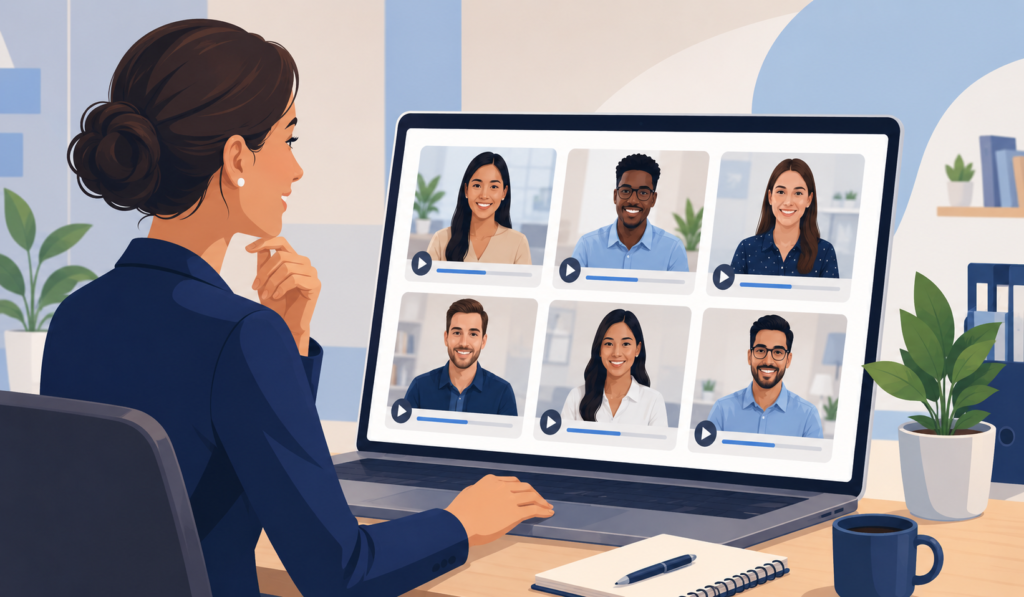
After the candidate submits the interview, the recruiter and hiring team review the recorded responses. They can score answers, leave comments, compare candidates, and decide who should move to the next stage.
This structure is useful because every candidate applying for the same role can answer the same questions. That makes comparison easier than informal first-round calls where each candidate may be asked different questions.
Example Tool: ScreeningHive
A practical example is ScreeningHive, a simple one-way video interview software built for recruiters who want to screen candidates without scheduling live first-round calls.
ScreeningHive allows hiring teams to create role-specific interviews, send secure links to candidates, and review recorded responses anytime. Its platform focuses on asynchronous video interviews, helping recruiters evaluate communication and role fit earlier while reducing manual effort in the first round.
It can be useful for remote hiring, high-volume recruitment, graduate hiring, customer-facing roles, and early-stage candidate screening. ScreeningHive also supports structured questions, candidate ratings, team feedback, and mobile-friendly access, making it easier for hiring teams to compare candidates in one place.
Why Do Companies Use One Way Video Interviews?
Companies use one-way video interviews because traditional first-round screening can become slow and repetitive. A recruiter may need to ask the same questions to dozens of candidates, arrange multiple calls, handle rescheduling, and then share feedback with hiring managers.
One-way video interviews reduce that manual effort and make screening more organised.
They Save Scheduling Time
Scheduling is one of the biggest problems in early hiring. Recruiters need to find a time that works for themselves, the candidate, and sometimes the hiring manager.
With a one-way video interview, the candidate records answers within a given deadline. This removes the back-and-forth of calendar coordination and helps recruiters move faster.
They Help Screen More Candidates
For high-volume roles, live first-round interviews can take up a lot of recruiter time. One-way video interviews allow recruiters to review candidate responses more flexibly.
For example, a recruiter hiring for a customer support role may receive hundreds of applications. Instead of booking a live call with every shortlisted candidate, they can send a one-way video interview and review communication skills before deciding who should progress.
They Make Screening More Consistent
When every candidate answers the same questions, hiring teams can compare responses more fairly. This is especially helpful when multiple recruiters or hiring managers are involved.
Google’s re:Work guide recommends structured interviewing with standardised questions and clear rubrics to improve hiring consistency and reduce bias.
A one-way video interview can support this approach because the questions are prepared in advance and candidates respond to the same format.
They Improve Remote Hiring
Remote hiring often involves candidates from different cities, countries, and time zones. Live calls can become difficult when candidates and recruiters are not available at the same time.
One-way video interviews allow candidates to complete the screening stage when they are available. Recruiters can then review responses during their working hours.
They Give Hiring Managers More Context
A CV can show experience, qualifications, and keywords, but it does not always show how a candidate communicates. A short video response can reveal confidence, clarity, tone, motivation, and role understanding.
This is useful for roles where communication matters, such as sales, customer support, HR, client success, hospitality, recruitment, and graduate hiring.
Where One Way Video Interviews Work Best
One-way video interviews are most useful when communication, confidence, or early-stage screening speed matters.
They work well for high-volume hiring because recruiters can review more candidates without scheduling every call. They are also useful for remote hiring because candidates can record responses across different locations and time zones.
For customer support hiring, recruiters can assess tone, clarity, and communication. For sales hiring, hiring teams can check confidence and persuasion style. For graduate hiring, large applicant groups can be screened more consistently.
Recruitment agencies can also use one-way video interviews to share candidate responses with clients or hiring managers. For first-round screening, they help reduce repetitive introductory calls and allow recruiters to focus on the most suitable candidates.
However, one-way video interviews should be used carefully. They are best for early screening, not for final decision-making. Candidates who perform well should still get the chance to speak with a recruiter or hiring manager in a live conversation.
What Questions Should Recruiters Ask?
The quality of a one-way video interview depends heavily on the questions. Generic questions often lead to generic answers. Strong questions are short, specific, and connected to the role.
For a customer support role, recruiters can ask: “How would you respond to an angry customer who feels ignored?”
For a sales role, they can ask: “How would you handle a prospect who says the product is too expensive?”
For an HR role, they can ask: “How would you manage follow-ups for multiple open roles?”
For a recruitment role, they can ask: “How would you judge whether a candidate is suitable after a short screening call?”
For a team lead role, they can ask: “Tell us about a time you handled conflict in a team.”
For a graduate trainee role, they can ask: “Describe a project where you solved a problem under pressure.”
Recruiters should avoid asking too many questions. For most first-round screening needs, three to five focused questions are enough.
Tips to Make One Way Video Interviews More Effective
A one-way video interview should feel simple for candidates and useful for recruiters. If the process feels confusing or too long, candidates may drop off.
Keep the Interview Short
A first-round video interview should not feel like a full final interview. Keep it short and focused. Candidates are more likely to complete the interview when the expectations are clear.
For most roles, three to five questions are enough. Each answer can be limited to one or two minutes. The total interview should ideally take around 10 to 15 minutes.
Explain the Purpose Clearly
Candidates should know why they are being asked to complete a one-way video interview. A short introduction can explain that the process helps the hiring team understand communication, role interest, and suitability before the next stage.
Clear instructions also make the process less stressful for candidates.
Use the Same Questions for Similar Candidates
For fairness, candidates applying for the same role should answer the same core questions. This makes the process easier to compare and supports more consistent hiring decisions.
Use a Scoring Rubric
Recruiters should score responses using clear criteria. This helps reduce subjective judgement and makes feedback easier to explain.
The scoring criteria can include communication, role understanding, confidence, problem-solving, and relevance of the answer. The focus should always stay on job-related qualities.
Give Candidates a Good Experience
A one-way video interview should not feel cold or robotic. Candidates should receive clear instructions, enough preparation time, and a simple process.
Recruiters should also tell candidates what will happen after submission. This reduces uncertainty and improves the candidate experience.
Are One Way Video Interviews Fair?
One-way video interviews can support fairer screening when they are structured properly. The same questions, clear scoring criteria, and shared review process can reduce inconsistency.
However, they should not be used carelessly. Recruiters should avoid judging candidates based on background, appearance, accent, or video quality. The focus should be on job-related answers.
A fair one-way video interview process should use the same questions for each role, apply clear scoring criteria, ask job-related questions, include multiple reviewers where needed, and give candidates clear instructions.
Recruiters should also make reasonable adjustments where needed. For example, if a candidate has accessibility needs, the hiring team should provide an alternative screening format.
One Way Video Interview vs Live Interview
One-way video interviews and live interviews serve different purposes.
A one-way video interview works well for first-round screening. It helps recruiters decide who should move forward. A live interview works better for deeper discussion, follow-up questions, culture fit, negotiation, and final-stage evaluation.
Use a one-way video interview when you need to screen many candidates, assess communication early, reduce scheduling delays, or create a consistent first-round process.
Use a live interview when you need deeper two-way discussion, direct hiring manager interaction, follow-up questions, salary discussion, or final-stage evaluation.
The best hiring process often uses both. A one-way video interview helps shortlist candidates, and a live interview helps confirm final suitability.
Common Mistakes to Avoid
One-way video interviews are useful, but only when they are designed properly.
One common mistake is asking too many questions. This can make the process feel tiring and reduce completion rates. A better approach is to keep the interview short and focused.
Another mistake is asking vague questions. Recruiters should ask role-specific questions that help them understand how the candidate may perform in real situations.
Recruiters should also avoid judging video quality too heavily. A candidate’s lighting or camera quality should not matter more than the quality of their answer.
It is also important to provide clear instructions. Candidates should know how long the interview will take, how many questions they will answer, and what happens after submission.
Finally, one-way video interviews should not remove all human contact from hiring. They should support early screening, not replace meaningful recruiter and hiring manager conversations.
Conclusion
A one way video interview is a simple way to screen candidates before arranging live interviews. It allows candidates to record answers to pre-set questions, while recruiters review responses later.
For hiring teams, this can reduce scheduling delays, improve first-round consistency, and make remote or high-volume hiring easier to manage. For candidates, it can offer more flexibility because they can complete the interview at a suitable time.
The best results come when one-way video interviews are short, structured, fair, and focused on job-related questions. Used correctly, they help recruiters save time while still giving candidates a clear opportunity to show communication, confidence, and role understanding.
FAQs
What is a one way video interview?
A one way video interview is a pre-recorded interview where candidates answer pre-set questions on video without joining a live call. Recruiters review the responses later.
How does a one way video interview work?
The recruiter creates questions, sends an interview link, and the candidate records answers before the deadline. The hiring team then reviews, scores, and compares the responses.
Why do recruiters use one-way video interviews?
Recruiters use one-way video interviews to save scheduling time, screen more candidates, assess communication, and make first-round hiring more consistent.
Is a one-way video interview the same as a live interview?
No. A one-way video interview is pre-recorded, while a live interview happens in real time. One-way interviews are usually used for early screening, while live interviews are better for detailed discussion.
What should candidates expect in a one-way video interview?
Candidates should expect a few pre-set questions, a time limit for each answer, and clear instructions on how to record and submit their responses.
Are one-way video interviews useful for remote hiring?
Yes. They are useful for remote hiring because candidates and recruiters do not need to be available at the same time. This makes screening easier across locations and time zones.